
What Is SEO? A Beginner’s Guide to Search Engine Optimization
What is SEO, and why does it matter?
Search engine optimization helps people find useful pages when they search online. It also helps search engines discover, understand, and present those pages in the right context.
That sounds simple. The confusing part is everything that sits underneath it.
SEO can involve keywords, content, site structure, page speed, links, local listings, analytics, and technical settings. Search results have also changed. A results page can now include standard links, maps, images, videos, shopping results, and AI-assisted answers.
You do not need to master all of that at once.
The best place to start is with the basic system. Learn how search works. Understand what people are trying to find. Build useful pages for those needs. Make those pages easy to crawl and use. Then measure what happens and improve over time.
This guide is the starting point. As you go deeper, BSD’s SEO strategies, tools, and analytics can help you explore specific topics in more detail.
What This SEO Guide Covers
This guide explains the main parts of SEO in plain language. You will learn how search engines find pages, what keywords and search intent mean, how to optimize a page, how technical SEO works, why links matter, how local SEO differs, and how to measure results.
- What SEO means and how it differs from paid search
- How crawling, indexing, and search results work
- The main types of SEO
- Search intent and keyword research
- On-page SEO and content optimization
- Internal links and website structure
- Technical SEO basics
- Backlinks and off-page SEO
- Local SEO
- SEO measurement and Google Search Console
- SEO for AI-assisted search
- Common mistakes and a beginner checklist
What Is SEO?
SEO stands for Search Engine Optimization. It is the process of improving a website so search engines can find and understand its pages, while making those pages useful for the people searching. The goal is relevant organic visibility, not simply getting the highest possible ranking for any keyword.
 Organic visibility means appearing in unpaid search results.
SEO does not mean paying Google to place a page at the top. Paid search ads are a separate channel. They can appear above or around organic results, but the advertiser pays for those placements or clicks.
SEO focuses on earning visibility by creating pages that match a real search need and making the website easy for search systems to access and understand.
A strong SEO strategy usually connects three things:
- Search demand: what people actually look for.
- Page value: whether your page gives them a useful answer, product, service, or next step.
- Technical access: whether search engines can reach, process, and understand the page.
If one part is missing, the result becomes weaker. Great content that cannot be crawled may never get a fair chance. A fast site with thin content may be easy to access but not useful. A page that targets a popular keyword but answers the wrong need can also struggle.
Why SEO Matters
SEO helps connect existing demand with useful pages. People already use search to research problems, compare options, find local businesses, learn new skills, and make buying decisions. SEO gives your website a better chance to appear during those moments without relying only on paid advertising.
One of the biggest advantages of SEO is that a useful page can keep being discovered after it is published.
An ad usually stops producing traffic when the budget stops. A useful search page can continue earning impressions and clicks as long as it remains relevant, accessible, and competitive.
That does not mean SEO is free. It takes time, writing, design, development, research, maintenance, and analysis. The difference is that you are investing in assets on your own website.
SEO can also support other marketing work. A well-structured article can answer questions before a sales call. A service page can explain an offer clearly. A local page can help nearby customers find a business. A strong resource can earn links and referrals from other websites.
The best SEO work is not separate from the customer experience. It improves how people find, understand, and use the site.
How Do Search Engines Work?
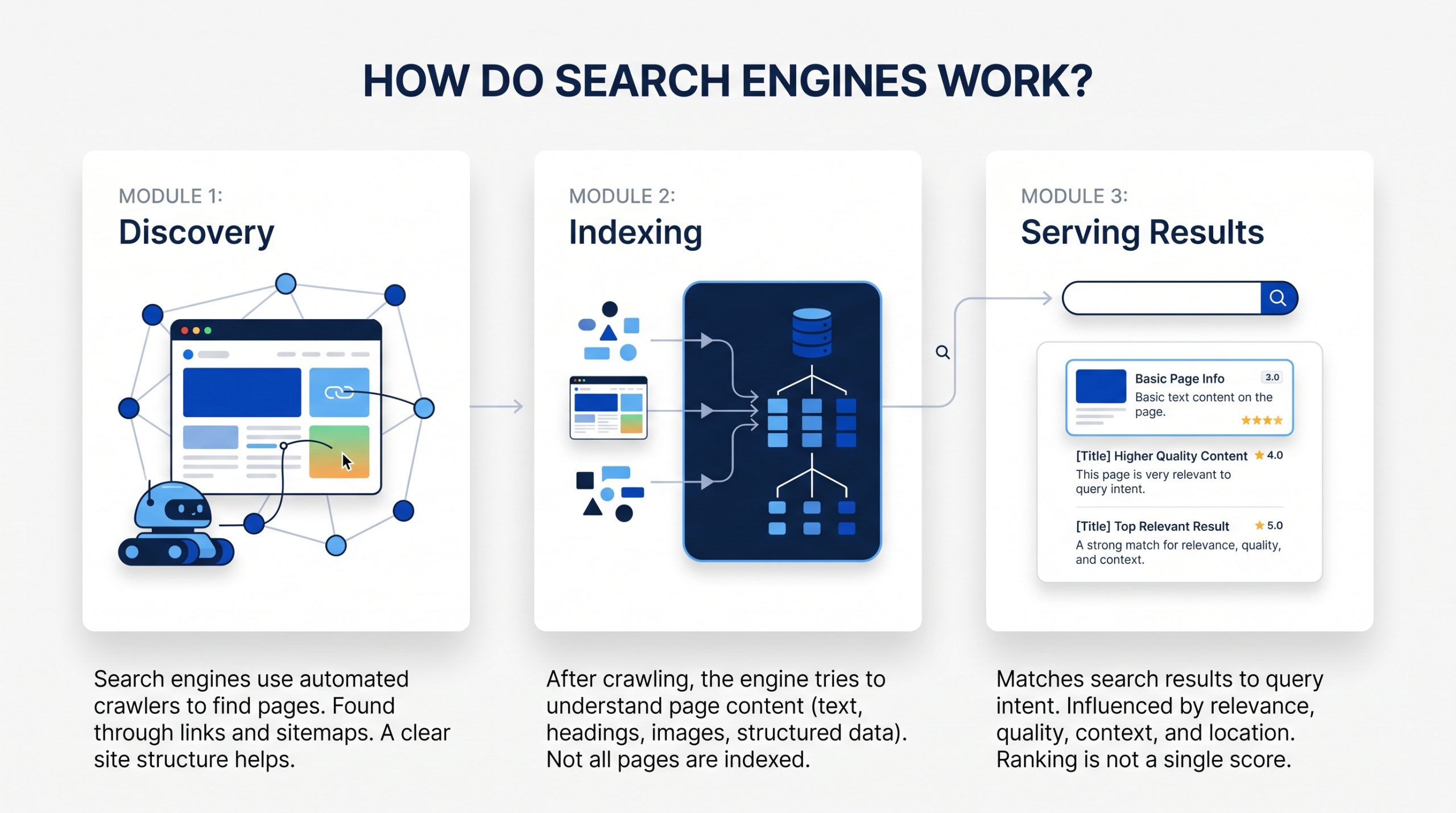
Search engines generally need to discover a page, understand and store information about it, then decide when it may be useful for a search. For beginners, it helps to think about three broad stages: crawling, indexing, and serving results. Each stage can affect whether a page becomes visible.
 1. Crawling: Finding Pages
Search engines use automated programs often called crawlers or bots to discover pages across the web.
They can find a page through links from other pages, through a sitemap, or because the URL is already known to the search engine.
Crawling does not mean a page will rank. It only means the search engine was able to reach and fetch it.
A clear website structure helps. Important pages should not be hidden behind broken links or isolated from the rest of the site.
2. Indexing: Understanding Pages
After a page is crawled, the search engine tries to understand what it contains.
It looks at the main text, headings, links, images, structured data, and other page signals. It also tries to understand which URL should represent the content when duplicate or very similar versions exist.
A page can be crawled without being indexed. Search engines do not have to keep every page they find.
3. Serving Results: Matching a Search
When someone searches, the search engine looks for results that fit the query and its likely intent.
Many systems and signals can influence which results appear. Relevance, quality, usability, context, location, and the type of search can all matter.
The important lesson for beginners is that ranking is not one score. There is no single switch that makes a page rank.
SEO improves the full set of signals that help a page become a strong match for the right search.
What Is a Search Engine Results Page?
A search engine results page, often called a SERP, is the page you see after entering a search. Modern SERPs can contain much more than traditional blue links. Depending on the query, you may see ads, local results, images, videos, rich results, shopping features, and AI-assisted answers.
This matters because SEO is no longer only about one list of ten links.
Different searches can produce very different layouts.
A local search may show a map and nearby businesses. A product search may show shopping features. A how-to search may include video or image results. An informational query may trigger an AI-generated overview with links to supporting sources.
Your SEO strategy should match the type of result people expect for the topic.
The Four Main Types of SEO
SEO is easier to understand when you divide it into four connected areas: on-page SEO, technical SEO, off-page SEO, and local SEO. Most websites use the first three. Local SEO becomes especially important when a business serves people in a specific area or has a physical location.
| SEO Area | What It Focuses On | Simple Example |
| On-page SEO | The content and elements on a page | Clear title, useful copy, headings, images, internal links |
| Technical SEO | How the website can be crawled, indexed, and used | Site speed, mobile experience, sitemaps, redirects, canonicals |
| Off-page SEO | Signals and references from outside the website | Relevant backlinks, mentions, digital PR |
| Local SEO | Visibility for location-based searches | Google Business Profile, reviews, location information, local citations |
These areas overlap. A strong article is still limited if the site has serious technical problems. A technically healthy site can still underperform if the content does not meet search intent. Good SEO brings the pieces together.
Search Intent Comes Before Keywords
Search intent is the reason behind a query. Before you choose a keyword, ask what the person is trying to accomplish. A page can mention the right phrase many times and still miss the search if it gives the wrong type of answer, format, or next step.
Imagine these searches:
- “what is SEO” suggests someone wants a beginner explanation.
- “SEO audit checklist” suggests someone wants a practical process or template.
- “SEO agency near me” suggests someone is comparing service providers.
- “Google Search Console login” suggests someone wants to reach a specific tool.
The topic is related in each case, but the intent is different.
That means the best page format may also be different. One query may need a guide. Another may need a service page, product page, comparison, local landing page, or quick answer.
Before writing, search the topic yourself. Look at the types of pages that appear. You are not copying them. You are learning what kind of result search systems currently see as useful for that query.
Keyword Research: Finding What People Search For
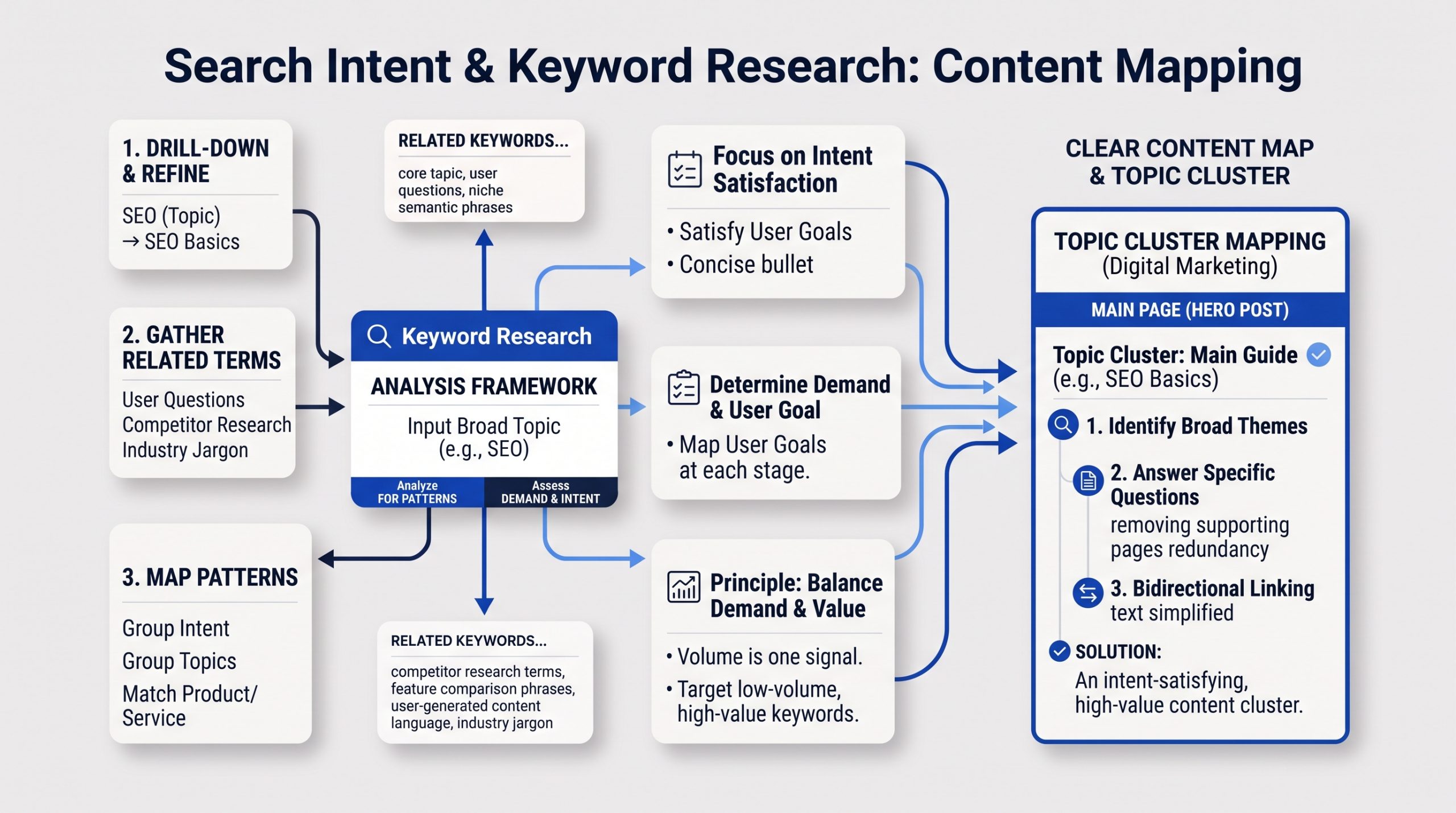
Keyword research is the process of learning the words and questions people use when they search. Good keyword research is not about collecting the biggest list. It is about understanding demand, intent, topic relationships, and which page on your site should answer each important search.
 Start with a broad topic that matters to your audience.
For example, a website about digital marketing may start with “SEO.” That topic can lead to more specific searches such as “SEO basics,” “keyword research,” “technical SEO,” “local SEO,” or “how long does SEO take.”
Then look for patterns.
Which terms describe the same intent? Which questions need their own page? Which searches are too different to combine? Which terms connect naturally to a product or service?
Search volume can help you estimate demand, but it should not be your only filter.
A low-volume term can still be valuable if it closely matches what your audience needs. A high-volume term can be useless if your page cannot satisfy the intent or the audience is wrong.
Keyword research works best when it leads to a clear content map. One main page can cover the broad topic. Supporting pages can answer narrower questions and link back to the main guide.
That is one reason hero posts matter. They create a strong starting point for a topic cluster instead of leaving related articles isolated.
On-Page SEO: Making Each Page Clear
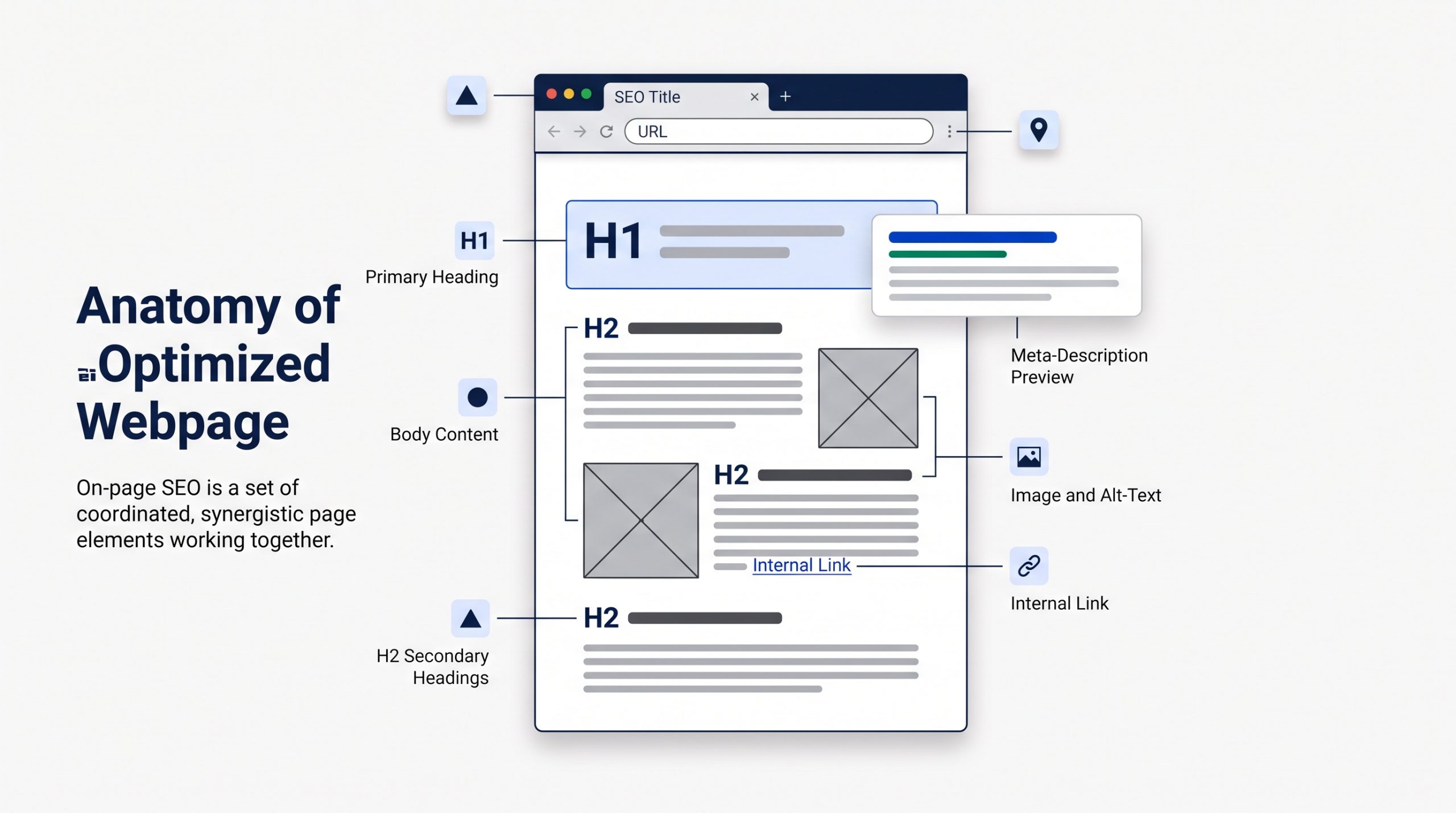
On-page SEO improves the content and visible structure of a page so people and search engines can understand it quickly. The goal is not to place a keyword everywhere. The goal is to make the topic, purpose, hierarchy, and next step clear from the title through the final paragraph.
 Page Title and SEO Title
The page title should explain what the page is about.
For a blog post, it should also give the reader a reason to click. Place the main topic early when it sounds natural.
The SEO title shown in search may be adjusted by the search engine, but writing a clear title still gives it strong source material.
Headings
Use one main H1 for the page title. Then use H2 and H3 headings to organize the content into clear sections.
Headings help readers scan. They also show how ideas relate to one another.
URLs
Keep URLs readable and focused.
A short slug such as /what-is-seo is easier to understand than a long URL filled with dates, filler words, or tracking terms.
Meta Descriptions
A meta description is a summary that search engines may use in the search snippet.
It is not a place to stuff keywords. Write a useful description that tells the searcher what they will get from the page.
Images and Alt Text
Images can help explain a topic and improve the page experience.
Use descriptive file names. Add alt text when the image communicates useful information. Alt text should describe the image in context, not repeat a keyword for SEO.
Internal Links
Internal links connect one page on your site to another.
They help people discover related information. They also help search engines understand how pages connect and which pages are important within a topic.
Use descriptive anchor text. Link to the next useful resource instead of adding links only to increase a count.
Content SEO: Create the Best Useful Answer You Can
Content SEO is the work of creating and improving pages so they fully answer a real search need. Useful content is accurate, focused, easy to understand, and supported by genuine knowledge or experience. Word count alone does not make a page helpful, and keyword repetition does not create expertise.
A short page can be excellent if the question is simple.
A detailed guide may need several thousand words because the topic has many parts.
The right length is the length required to do the job well.
Strong content usually does a few things clearly:
- Answers the main question early.
- Explains the details a beginner may not know.
- Uses examples where they make the idea easier to understand.
- Shows first-hand knowledge, original insight, or a clear point of view when relevant.
- Keeps information accurate and up to date.
- Makes the next step easy to understand.
Google continues to emphasize helpful, reliable, people-first content. That means SEO should support the reader, not turn the article into a collection of repeated phrases.
For a topic like SEO, freshness also matters. Search tools, interfaces, and search features change. Evergreen explanations should be reviewed when the platforms around them change.
Internal Linking and Website Structure
A clear website structure helps both visitors and search engines understand where information belongs. Important pages should be reachable through normal navigation and useful internal links. Related pages should support one another instead of competing, duplicating the same topic, or sitting alone without context.
Think of your website like a library.
The homepage is not the only useful page. Categories, service pages, guides, and supporting articles should be organized so a person can move from a broad topic to a more specific one.
For SEO, that often means creating a topic hub.
A hero article can explain the broad subject. Supporting posts can cover keyword research, technical SEO, local SEO, analytics, backlinks, or AI search in more depth. Those supporting posts should link back to the hero article, and the hero article should link out when a deeper explanation is useful.
The technical side of that structure is closely tied to website design and development. Navigation, mobile usability, content structure, and performance all shape how easy a site is to use and maintain.
Technical SEO: Making Sure the Site Can Be Found and Used
Technical SEO focuses on the systems behind the page. It helps search engines crawl and index important URLs and helps users access the site without unnecessary friction. You do not need to be a developer to understand the basics, but technical problems can block otherwise strong content.
 Crawlability and Indexing
Important pages need to be reachable by search engines.
Site navigation, internal links, robots settings, and server responses all affect access. If a page is blocked, broken, or returns the wrong status code, it may be difficult to process correctly.
Indexing is a separate step. A page can be crawled but not added to the index.
XML Sitemaps
An XML sitemap gives search engines a list of URLs you want them to know about.
It can help discovery, especially on larger or newer sites. A sitemap does not guarantee that every listed page will be indexed.
Canonical URLs
Sometimes several URLs contain the same or very similar content.
Canonical signals help search engines understand which version you prefer as the main URL.
Redirects and Broken Pages
When a page moves, use the right redirect so users and search engines reach the new location.
Broken links and long redirect chains create friction. They also make site maintenance harder.
Mobile Experience and Page Performance
Your pages should work well on phones, tablets, and desktops.
Google recommends looking at page experience as a whole. Core Web Vitals are useful measures, but they are not the only thing that matters. Security, mobile usability, intrusive interruptions, and the clarity of the main content also affect the experience.
Structured Data
Structured data is code that describes specific information on a page in a machine-readable format.
When it matches supported search features and accurately reflects the visible content, it can help search engines understand the page and may make it eligible for richer search appearances.
Structured data is not a guarantee of a rich result, and it does not replace useful content.
Off-Page SEO and Backlinks
Off-page SEO covers signals that happen outside your own website. Backlinks are one important part. A backlink is a link from another site to yours. Relevant links can help search engines discover pages and can support the wider signals that show a site or resource is known and referenced online.
Not all backlinks have the same value.
A useful link usually makes sense for the reader. It may come from an industry publication, a trusted partner, a useful directory, a news story, a research citation, or another site that genuinely wants to reference your resource.
Buying large batches of low-quality links is not a shortcut worth building a strategy around.
A better long-term approach is to create things that deserve references. That can include original research, strong guides, useful tools, templates, case studies, or expert commentary.
It is also important to separate Google’s own search systems from third-party SEO scores. For example, Domain Authority is not a Google ranking score, even though it can be a useful comparison metric inside some SEO tools.
Use third-party metrics as indicators, not as the final goal.
Local SEO: Getting Found in a Specific Area
Local SEO focuses on searches connected to a place. It matters most for businesses with physical locations or defined service areas. The goal is to make the business easy to understand and verify across its website, Google Business Profile, reviews, local mentions, and trusted business listings.
Google says local results are mainly influenced by relevance, distance, and prominence.
Relevance is how well the business matches the search. Distance considers how far the business is from the searcher or location used in the query. Prominence reflects how well-known the business is, including information from links and reviews.
For local SEO, start with accurate basics.
- Use complete and current business information.
- Keep the business name, address, phone number, hours, and categories accurate.
- Create useful location or service-area pages when they serve a real need.
- Ask for genuine customer reviews and respond to them professionally.
- Keep important listings consistent across trusted platforms.
For Philippine businesses, accurate listings in relevant business directories can support a clearer local footprint when the directories are reputable and the information stays consistent.
Do not create dozens of thin location pages that say the same thing with only the city name changed. Each location page should have a real reason to exist.
How to Measure SEO Results
SEO measurement should show whether the right people are finding and using your pages. Rankings can be useful, but they are only one signal. Search Console, analytics data, conversions, and business outcomes give a more complete view of whether SEO is creating useful visibility.
Google Search Console is one of the best places to start.
Its Performance reports can show clicks, impressions, click-through rate, and average position. You can also view performance by query, page, country, device, date, and search appearance.
Each metric answers a different question.
- Impressions show how often your site was seen in eligible search results.
- Clicks show how often someone clicked through to your site.
- CTR shows the share of impressions that became clicks.
- Average position gives a broad view of where your highest result appeared, but read it as a trend rather than a perfect rank tracker.
Then connect search data to what happens on the site.
Did visitors read the article? Did they explore another page? Did they submit a form, call, sign up, or buy?
The best metric depends on the page.
A beginner guide may be successful because it earns discovery and assists future visits. A service page may be more directly tied to enquiries. An ecommerce category page may be measured against sales and revenue.
Traffic matters. Relevant traffic matters more.
SEO and AI Search in 2026
AI-assisted search changes how information can be presented, but it does not replace the foundations of SEO. Search systems still need accessible pages, clear information, useful content, and reliable signals. Google’s current guidance says established SEO practices continue to apply to its generative AI features.
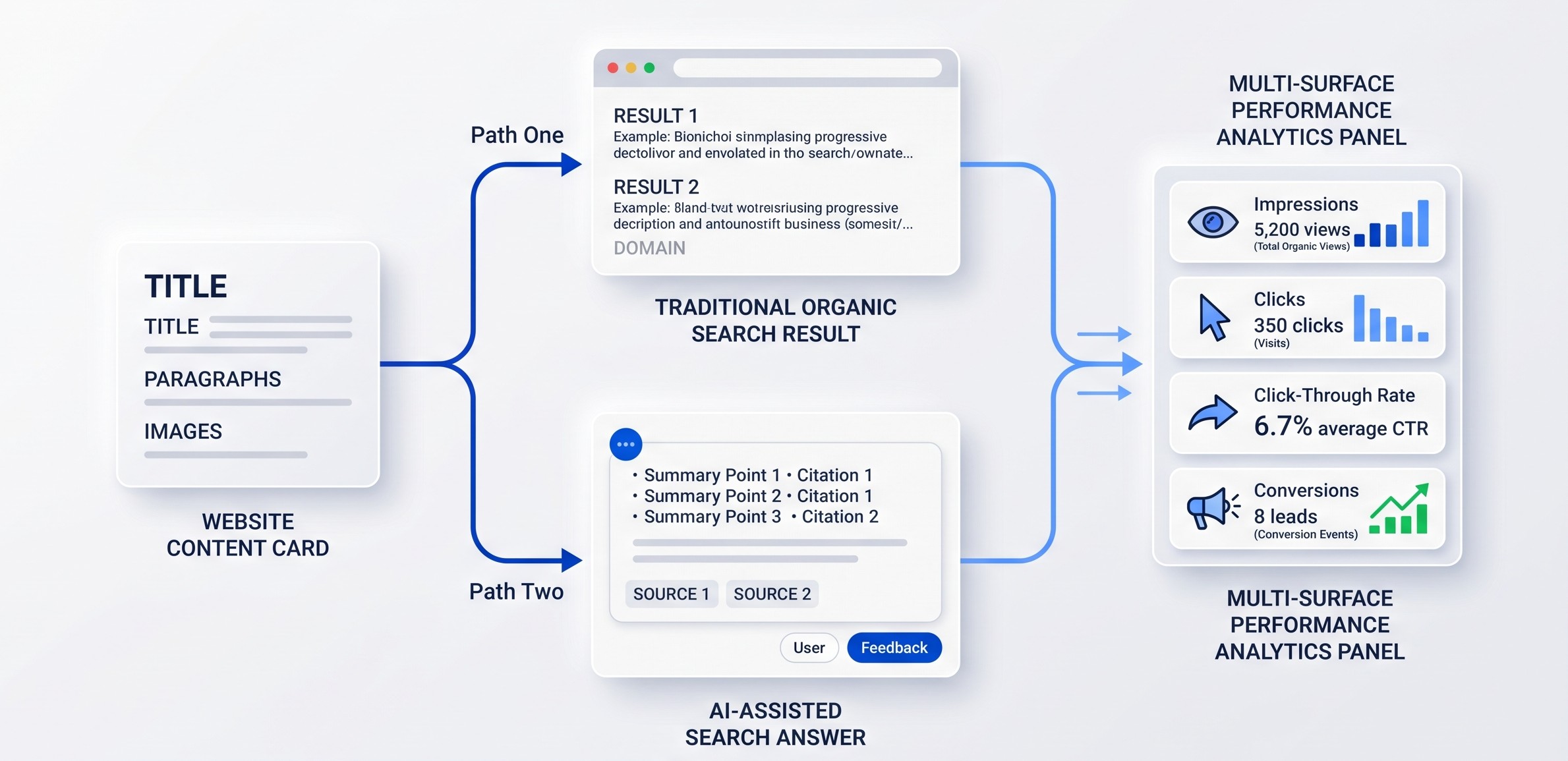 For site owners, that means you do not need a separate version of your website for AI search.
Keep your important pages crawlable. Answer questions clearly. Use headings that make the structure obvious. Add original details that make the page more useful than a generic summary. Use structured data when it accurately describes visible content.
Google also clarified in June 2026 that llms.txt files are not needed for Google Search and do not improve or hurt visibility or rankings there.
Search measurement is evolving too. AI Mode traffic now contributes to Search Console totals, and Google added reporting for web multimodal search in September 2026. That gives site owners more ways to understand discovery beyond traditional typed searches.
This wider shift toward AI search visibility is another reason to build strong web fundamentals instead of chasing one new optimization trick.
The search interface will keep changing. Clear, useful, well-structured information is still the safest foundation.
How Long Does SEO Take?
SEO is usually a long-term process, not an instant result. Search engines need time to discover changes, process pages, compare them with other results, and respond to new signals. The timeline depends on the website, competition, topic, technical condition, content quality, and strength of the existing brand.
Some changes can be noticed quickly.
Fixing a broken page, improving a title, or submitting a sitemap can have a visible effect sooner than building authority in a highly competitive market.
New websites often need more time because they have less history, fewer links, and less content.
Established sites may see faster movement on pages that already receive impressions.
Do not judge SEO only by whether one keyword moved this week.
Watch broader trends. Are relevant impressions growing? Are more useful pages earning clicks? Are conversions from organic search improving? Are technical problems decreasing?
SEO is easier to manage when you treat it as ongoing improvement instead of a one-time launch task.
Common SEO Mistakes Beginners Should Avoid
Most beginner SEO mistakes come from focusing on a tactic instead of the user and the full system. Keyword stuffing, thin pages, duplicated content, low-quality links, poor site structure, and chasing tool scores can all waste time. The basics work better when they are applied consistently and in context.
Keyword Stuffing
Repeating the same phrase again and again can make the page hard to read. Use the main keyphrase naturally, then use related language where it helps explain the topic.
Creating a Page for Every Tiny Keyword Variation
Several searches may share the same intent. One strong page can often cover them better than many thin pages that compete with each other.
Ignoring Search Intent
A keyword is not enough. Make sure the page format and answer match what the searcher is trying to do.
Publishing Without Internal Links
New content should connect to relevant pages on the site. Do not leave useful articles isolated.
Chasing One SEO Score
Tool scores can help diagnose issues, but no single score tells you whether a page will rank or convert.
Buying Low-Quality Links
Links created only to manipulate rankings can create risk. Build useful resources and earn relevant references instead.
Treating SEO as a One-Time Project
Search behavior, competitors, content, websites, and search features change. Review important pages and data regularly.
A Beginner SEO Checklist
You do not need to fix everything at once. Start with the pages that matter most, make sure search engines can access them, improve how well they answer real searches, connect them through internal links, and track performance. Then expand into deeper technical, content, local, and authority work.
- Set up Google Search Console and confirm the correct website property.
- Check that important pages can be crawled and indexed.
- Create or submit an XML sitemap.
- Choose one clear purpose and main topic for each important page.
- Research the search intent before choosing the target keyphrase.
- Write clear page titles, headings, URLs, and meta descriptions.
- Create useful content that answers the topic fully without keyword stuffing.
- Add descriptive internal links between related pages.
- Check mobile usability, loading performance, HTTPS, redirects, and broken pages.
- Use relevant structured data only when it matches visible content.
- Build real references, mentions, and backlinks over time.
- If location matters, keep your Google Business Profile and local listings accurate.
- Review Search Console data for impressions, clicks, CTR, queries, and page trends.
- Update important content when facts, tools, or search features change.
SEO Terms Beginners Should Know
SEO has a lot of vocabulary, but you only need a small group of terms to follow most beginner conversations. Learning these definitions makes technical guides, reports, and SEO tools much easier to understand.
| Term | Definition |
| SERP | The search engine results page shown after someone searches. |
| Keyword | A word or phrase connected to what people search for. |
| Search intent | The goal behind the search. |
| Crawl | When a search engine fetches a page to discover or process it. |
| Index | The collection of pages and information a search engine may use for results. |
| Organic result | An unpaid search result. |
| Backlink | A link from another website to your site. |
| Internal link | A link from one page on your site to another page on the same site. |
| Canonical | A signal that identifies the preferred version of similar or duplicate URLs. |
| XML sitemap | A machine-readable list of URLs that helps search engines discover site pages. |
| Structured data | Machine-readable markup that describes specific information on a page. |
| CTR | Click-through rate, or the percentage of impressions that result in clicks. |
BSD Perspective
At BSD, we see SEO as part of the whole digital experience. A page can be technically optimized and still fail if the message is unclear, the content is weak, or the website is difficult to use. Good SEO connects search intent, content, design, development, and measurement.
The most useful question is not “How do we make Google like this page?”
A better question is “How do we make this page easier to find, understand, trust, and use?”
That changes the work.
Keyword research becomes audience research. On-page SEO becomes clearer communication. Technical SEO becomes better access and performance. Internal linking becomes useful navigation. Analytics becomes a way to learn what people actually do.
Search engines will continue to change. The specific features may look different next year.
A useful website with clear information, strong structure, and a real reason to exist is a much more durable investment.
Start With the SEO Basics, Then Build From There
What is SEO? At its core, SEO is the practice of helping the right people discover the right page through search. It combines useful content, clear structure, technical access, internal and external signals, and ongoing measurement. The advanced tactics make more sense once this foundation is clear.
You do not need to become an SEO specialist before improving your website.
Start with the basics.
Understand what your audience searches for. Build the right page for that need. Make the page easy to read and easy to reach. Connect it to the rest of your site. Keep the technical foundation healthy. Measure what happens.
Then improve one layer at a time.
If your website needs stronger structure, content, performance, or search visibility, explore how BSD approaches website and digital marketing work as part of one connected system.
Frequently Asked Questions About SEO
Is SEO the same as Google Ads?
No. SEO focuses on unpaid organic visibility. Google Ads is paid advertising. Both can appear on search results pages, but they use different systems and budgets.
Do I need to use my exact keyword many times?
No. Use the main phrase naturally in important places, then explain the topic in normal language. Related terms and clear context are more useful than forced repetition.
Can I do SEO without technical skills?
Yes, you can handle many basics such as keyword research, titles, content, headings, internal links, and Search Console. More complex indexing, performance, migration, or server issues may need developer support.
Do backlinks still matter?
Relevant links still matter as part of how pages are discovered and how the web connects information. Focus on useful, earned references rather than buying large volumes of low-quality links.
Does structured data improve rankings?
Structured data can help search engines understand specific page information and can make a page eligible for certain rich search features. It does not guarantee a rich result or a ranking increase.
Is SEO still important with AI search?
Yes. AI-assisted search still depends on strong web content and search systems. Accessible pages, clear answers, useful information, and reliable signals remain important even as the search interface changes.

Related Posts

Evergreen Content: Why It Matters for SEO and Traffic
Evergreen content can keep attracting readers long after it is published. Learn…

Why Did My Domain Authority Go Down? Reasons and Solutions
Wondering why your Domain Authority score dropped? This beginner-friendly guide…

How to Show Your Company in ChatGPT: The Ultimate Guide to Getting Found in AI Conversations (2025)
Learn how to get your business mentioned in ChatGPT by optimizing your content,…
[…] you are still learning how organic search works, start with What Is SEO? A Beginner’s Guide to Search Engine Optimization. It explains the SEO basics behind search visibility, keywords, content, technical setup, and […]
[…] you are still building your SEO foundation, What Is SEO? A Beginner’s Guide to Search Engine Optimization explains how useful content, search intent, keywords, links, and technical setup work together to […]