

How to Tell a Brand Story People Actually Remember
 Every business has a story.
The hard part is knowing which parts are worth telling.
A brand story is not a long company history. It is not a list of milestones either.
It is the clear story behind why your business exists, who it helps, what it believes, and what changed because of the work you do.
Good brand storytelling makes that story easier to understand and easier to remember.
If you want to build a stronger brand, your story should support the same purpose, message, and experience people see everywhere else.
The goal is not to make your business sound dramatic.
The goal is to make it feel human, clear, and true.
What Brand Storytelling Really Means
Brand storytelling is the way a business uses real people, purpose, problems, change, and proof to explain what the brand stands for. A strong story gives customers context. It helps them understand why the business exists and why its work should matter to them.
Your story can include how the business started.
But the starting point is only one part of it.
The stronger question is: what belief or problem has stayed important as the business grew?
Maybe you started because customers were being ignored.
Maybe an industry process felt harder than it needed to be.
Maybe you saw a better way to deliver a service.
That idea can become the thread that connects your past, present, and future.
Research on narrative transportation helps explain why stories can be useful in marketing. A review looked at 95 peer-reviewed studies. It found that being drawn into a story can shape how people respond to marketing messages.
That does not mean every brand needs a dramatic plot.
It means a clear story can give facts more meaning.
Start With the Truth Behind the Business
The best brand stories begin with something real. Start with the reason the business exists, the problem you wanted to solve, or the belief that shaped your approach. A true starting point is easier to explain and easier to support with real actions.
 Do not begin by asking, “How can we make this sound impressive?”
Ask, “What is actually true about us?”
Think about the early choices that still matter today.
Why did you choose this work?
What frustrated you about the old way?
What did you want customers to experience instead?
The answer does not need to be heroic.
Simple stories can be strong when they are specific.
A founder may have started a company after seeing clients struggle with slow service. A family business may have grown around one promise: make the process easier to understand.
Those ideas should also connect with your brand identity. The story, visuals, voice, and values should point in the same direction.
If the story says one thing and the brand feels like another, people may not know what to believe.
Make the Customer Part of the Story
Your business can start the story, but the customer should have a clear place in it. Show the problem they face, the change they want, and how your business helps them move forward. This keeps the story useful instead of making it only about the company.
Many brand stories focus too much on the founder.
We started here. We won this. We grew this much.
Those facts can matter. But customers are usually asking a different question.
“What does this mean for me?”
A useful brand story connects your reason for existing with the change the customer wants.
For example, a design studio may have started because too many good businesses looked unclear online.
The customer story is the other half.
A growing business wants to look as strong as the work it already delivers.
Now the story has a problem, a person, and a reason to care.
Current storytelling guidance from HubSpot also recommends making the customer the main character while the brand acts as a guide.
That shift can make the story feel more relevant and less self-focused.
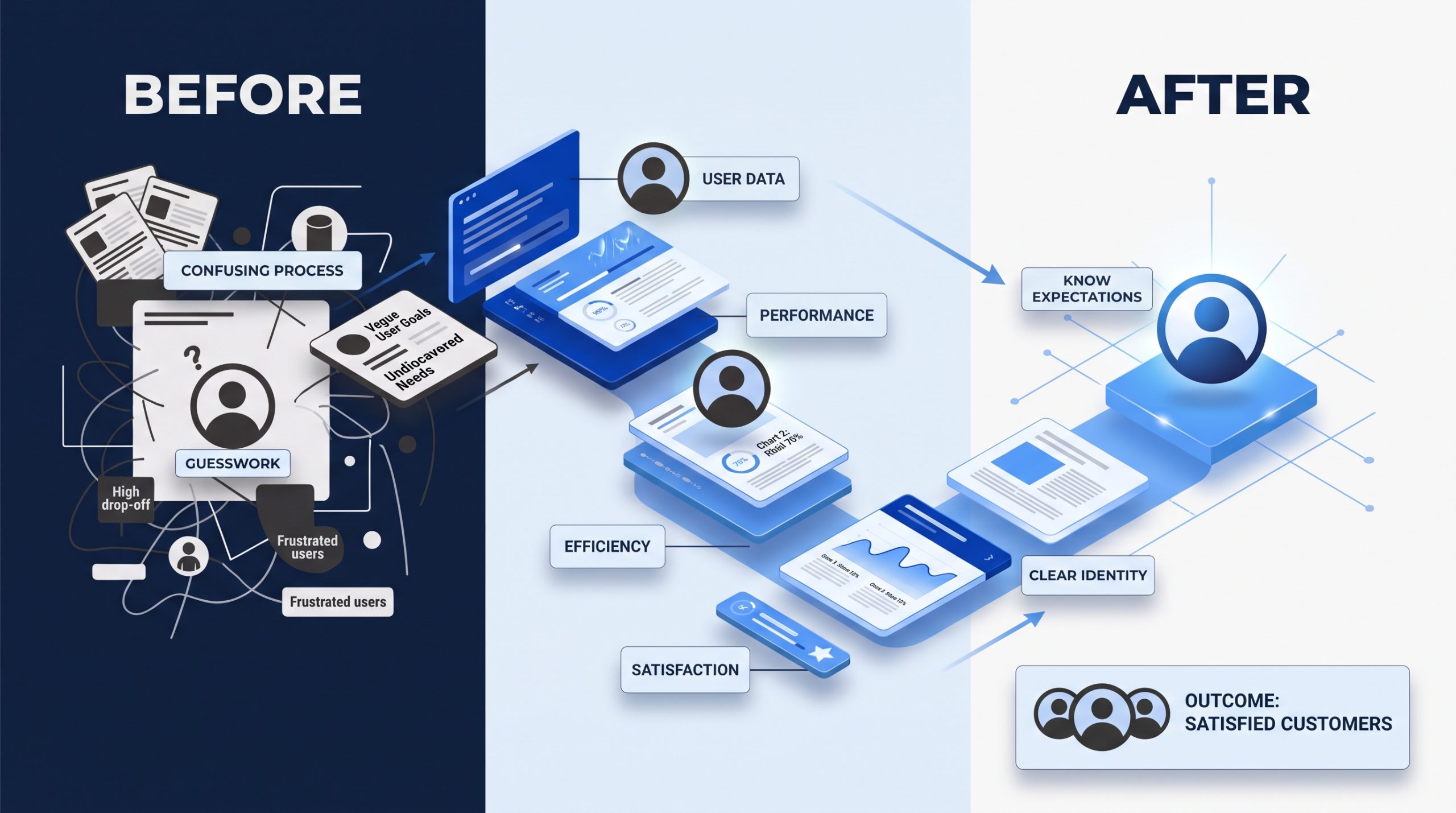
Give the Story a Clear Before and After
Stories become easier to follow when something changes. Show what the customer, business, or industry looked like before. Then show what became possible after a better choice, new idea, or different approach. The change gives the story shape and makes the value easier to see.
 You do not need to force drama.
You only need a clear contrast.
Before, the process was confusing. Now it feels simple.
Before, the brand looked like everyone else. Now it has a clear identity.
Before, customers had to guess. Now they know what to expect.
This is where proof matters.
Use real examples, customer stories, process details, results, or lessons.
A claim like “we care about customers” is easy to say.
A story about changing your process because customers kept facing the same problem is much stronger.
Specific details make the message easier to picture.
They also give the story something people can believe.
Use a Voice That Sounds Like the Brand
A strong brand story should sound like the same business people meet everywhere else. Keep the tone clear and natural. Use the words your team would really use. A story loses trust when it feels too polished, too dramatic, or far removed from the real brand.
Brand voice matters because the story is not only about what you say.
It is also about how you say it.
A premium firm may sound calm and precise.
A youth brand may sound lively and direct.
A technical company may still be clear without sounding cold.
Do not add emotion just to make the copy feel more like a story.
Let the real details carry the feeling.
A good rule is simple.
If the story would sound strange when spoken by someone on your team, rewrite it.
The goal is not perfect prose.
It is a voice people can connect with and recognize.
Repeat One Core Story Across Different Touchpoints
Your brand story should stay consistent even when the format changes. A website may tell the full version. Social media may share one moment. A case study may show proof. An email may focus on one lesson. Each piece should still support the same core idea.
 This is where brand consistency matters. A story becomes easier to remember when people meet the same values, message, and personality across different channels.
You do not need to copy the same paragraph everywhere.
Instead, give each channel a job.
Your About page can explain the full story.
Your homepage can show the main promise.
Social posts can share lessons, people, or moments from the story.
Case studies can show the change in real life.
Your website design can bring those pieces together through copy, visuals, structure, and customer proof.
The format can change.
The meaning should not.
Let the Story Grow Without Losing the Core
Your brand story can change as the business grows. New services, markets, people, and lessons can add new chapters. The core idea should stay clear. This helps the brand feel current without making customers relearn what the business stands for.
A company story should not be frozen in the year it started.
The business may be very different now.
That is fine.
Keep the parts that still explain who you are.
Add the moments that show how the business has grown.
You may have new client stories.
You may have learned a better way to solve the problem.
You may have expanded the mission.
The story should reflect that change.
But do not rewrite the brand every time something new happens.
Think of the core story as the thread.
The details can grow around it.
A Simple Brand Story Framework
If your business story feels too broad, reduce it to four parts: the problem you saw, the belief that guided you, the change you help create, and the proof that shows the story is true. This gives your team a simple base for future content.
Try finishing these four lines:
We saw…
We believed…
So we built…
Now our customers can…
Then add proof.
That proof can come from customer feedback, case studies, real results, team habits, or the way your process works.
This simple version can become the base for your About page, sales deck, social content, and company introduction.
It does not need to tell every detail.
It only needs to make the most important idea clear.
BSD Perspective
At BSD, we see brand storytelling as a way to make strategy easier to understand. The story should explain the thinking behind the brand, not cover weak positioning with better words. When the business, message, identity, and customer experience support the same idea, the story feels more believable.
A business often has more story than it realizes.
It shows up in why the founders started.
It shows up in the problems the team refuses to ignore.
It shows up in how clients are treated and how decisions are made.
The work is not to invent a better story.
The work is to find the real one, make it clear, and tell it with enough consistency that people remember it.
Tell the Story People Need to Remember
Brand storytelling works best when it turns a real business story into one clear idea people can carry with them. Start with truth. Make the customer part of it. Show change. Use proof. Keep the voice natural. Then repeat the same core story across the brand.
Your business story does not need to sound like a movie.
It needs to sound like you.
Choose the parts that explain why the business matters.
Connect them to the people you serve.
Then make sure the experience supports what the story says.
That is how a business story becomes part of a brand.
And that is how a brand becomes easier to remember.

Related Posts

What Makes a Brand Memorable? 7 Elements That Help You Stand Out
Memorable brands are easier to recognize and trust. Explore seven elements that…


Positioning Your Expertise: The Key to Attracting Clients
Positioning your expertise helps potential clients understand your value before…

How to Select the Perfect Color for Your Brand
Brand colours shape first impressions. Learn how to choose a palette that fits…